


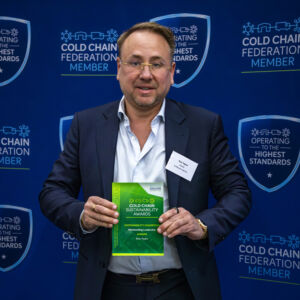
Ross Taylor Wins Cold Chain Sustainability Outstanding Leadership Award
Recognising Ross Taylor's leadership and dedication to advancing sustainability initiatives that are helping shape the future of refrigerated transport.
Read more
Reducing our environmental impact requires action, and these are some of the ways we’re delivering it.
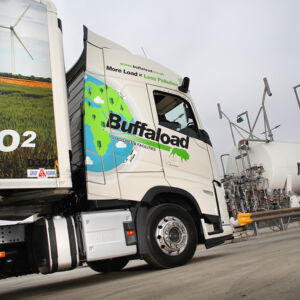
Our double-decker trailer fleet delivers up to 60% more capacity than a conventional single-deck trailer, reducing the number of journeys required to move goods. This improved efficiency lowers fuel consumption, decreases tyre wear and supports meaningful reductions in CO₂ emissions.
In 2025, we took further steps by partnering with certified BioLNG suppliers, from locally produced, carbon-negative fuel generated from organic waste and supplied through on-site refuelling, to national renewable fuel networks. Together, these partnerships enable average carbon emission reductions of up to 70% compared with conventional diesel, helping customers lower the environmental impact of their supply chains.
Buffaload has been at the forefront of cleaner fuel technology, becoming an early adopter of LNG-powered vehicles. Today, more than 60% of our fleet has transitioned from diesel to LNG, delivering an immediate reduction in tailpipe CO₂ emissions of up to 25% compared with a standard Euro 6 diesel tractor unit, without compromising payload capacity, operational performance or service reliability.
Buffaload has invested in the UK’s first double-deck refrigerated trailers equipped with Carrier Transicold’s Vector HE 19 Low CO₂ technology. Using an ultra-low GWP refrigerant and advanced refrigerant retention systems, these units can reduce refrigeration-related carbon emissions by up to 89% compared with current industry standard systems. The technology significantly reduces the environmental impact of cold chain operations while maintaining the high levels of temperature control, efficiency and reliability our customers depend on.
The business is continually adapting policy, trialing initiatives and introducing future proofed and modern ways to reduce carbon across out business. Recent initiatives include: